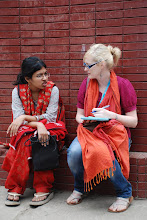
After three months in Bangladesh it’s time to get out, take a break and come back ready to knuckle down. So this time next week I’ll be on a plane to China, to see Pi, travel to Xi’An and around the Yunnan Province with Emma, enjoy some wine, great food, shopping and fabulous conversation. I almost can’t imagine how luxurious it all will be.
Yesterday I went south-east to a town called Noakali to meet some of UNICEF’s child journalists. They are a great bunch of kids, and it’s an amazing project. The children (aged 13 – 18) receive journalism training and the support of a team leader to write a report every other month about child rights violations in their district. Free from the political motivations of adult journalists and understanding of the plight of other children, these child journalists are writing objective reports that are taken seriously, even by government. And, to be selfish about it, it’s nice to meet some children who have happy, prosperous lives ahead of them.
Noakali itself is beautiful and green and peaceful, and even has a Ghandi Tribute Museum that we stopped at on our way back to Dhaka.
The things I see here on a daily basis are cause for much reflection. I don’t want to become accustomed to the staring or the begging or the poverty that surrounds me. At the same time, if I let it affect me, it’s hard to survive.
It’s funny to think it’s possible to travel across the world to discover what it is in life you DON’T want.
Perhaps it’s more a sign that my generation, with our endless opportunities and the world at our feet, is hard to please. Never happy with what we have. Thinking the grass is always greener.
But if nothing else, this year seems to be showing me what is important in life. Namely, having the people you love around...because what good is a life full of adventure, travel and amazing experiences if you don’t have someone to share them with?
And it’s quite possible that I’ve come all this way to realise that, actually, what I want I had all along. And there are things I have lost now by coming here, but I suppose it’s all in the name of becoming a better person. So it’s hard to regret that at least.
Happy Birthday Vin.
Friday, February 6, 2009

Ooooh nice...the object of sexual objectification
One of the first things I noticed here and one of the hardest things to cope with due to its unrelenting persistence is the staring. Now, it’s one thing to stare at me because I’m white (that’s the curious stare), but it’s another to stare at me because I’m a white woman (that’s the perverted stare).
Gender relations in Bangladesh leaves something to be desired. It’s ok for you to stare at my chest, but it’s not okay for me to hug my male friend...please explain? Apart from a few ‘out there’ young couples, there is a distinct lack of public affection between the sexes. Even an innocent pat on the back (or butt slap...go figure) is inappropriate.
I know it doesn’t sound like something that would cause great anxiety, but actually after a stressful day a hug (or butt slap) may be required. Also we all know self control isn’t my strong point. Can’t have something? Sorry, what? All I can see is this huge red flag...
Don’t get me wrong, not all affection is forbidden. In fact, it is very common to see men holding hands, and occasionally women, but male-female touching is strictly out of bounds.
If staring were an Olympic sport, Bangladesh would take gold. And I’m not just talking about the staring at bideshi’s...but staring at anything of the remotest interest. Laying a driveway? Changing a tyre? I’m gonna stick around and watch for awhile.
This isn’t a massive problem for me, because as any of my exes will testify, I have an uncanny ability to block out or ignore things (sometimes even whole conversations). It’s when the staring turns into blatantly sexual observation that I have a problem.
“Oooh nice” is a phrase I hear often. This comment, unlike many of the others (“hey baby/sexy”, etc) which are said quietly in passing, is blatant in its directness...usually said as he is approaching and has had a chance to give you a full look over. Should I be honoured that he really thinks so?
The jeering combined with the staring and occasional ass grabbing is too much some days. And it makes me think that sexual repression has a lot of answer for.
Sexuality is such a different kettle of fish here. In western cultures we revel in revealing womanly curves in a subtle way (ok, ok and sometimes not so subtly). Here, every curve is observed, almost because of attempts to cover them up. The salwar (pants) is high waisted and long legged (to hide those sexy ankles), the kameez (top) is long to prevent the showing of flesh and the orna (scarf) should be worn across the chest to hide womanly contours. Still, they look.
I’ve never felt more observed in my life.
But it is something that you learn to accept and surely part of the reason we are here is to gain a deeper cultural understanding and build relationships to further cultural exchange. As much as there is to be saddened by the traditional and often horrific gender abuses in Bangladesh, you can see things are changing (however slowly) and that, in most part, there is a recognition of this need.
Gender relations in Bangladesh leaves something to be desired. It’s ok for you to stare at my chest, but it’s not okay for me to hug my male friend...please explain? Apart from a few ‘out there’ young couples, there is a distinct lack of public affection between the sexes. Even an innocent pat on the back (or butt slap...go figure) is inappropriate.
I know it doesn’t sound like something that would cause great anxiety, but actually after a stressful day a hug (or butt slap) may be required. Also we all know self control isn’t my strong point. Can’t have something? Sorry, what? All I can see is this huge red flag...
Don’t get me wrong, not all affection is forbidden. In fact, it is very common to see men holding hands, and occasionally women, but male-female touching is strictly out of bounds.
If staring were an Olympic sport, Bangladesh would take gold. And I’m not just talking about the staring at bideshi’s...but staring at anything of the remotest interest. Laying a driveway? Changing a tyre? I’m gonna stick around and watch for awhile.
This isn’t a massive problem for me, because as any of my exes will testify, I have an uncanny ability to block out or ignore things (sometimes even whole conversations). It’s when the staring turns into blatantly sexual observation that I have a problem.
“Oooh nice” is a phrase I hear often. This comment, unlike many of the others (“hey baby/sexy”, etc) which are said quietly in passing, is blatant in its directness...usually said as he is approaching and has had a chance to give you a full look over. Should I be honoured that he really thinks so?
The jeering combined with the staring and occasional ass grabbing is too much some days. And it makes me think that sexual repression has a lot of answer for.
Sexuality is such a different kettle of fish here. In western cultures we revel in revealing womanly curves in a subtle way (ok, ok and sometimes not so subtly). Here, every curve is observed, almost because of attempts to cover them up. The salwar (pants) is high waisted and long legged (to hide those sexy ankles), the kameez (top) is long to prevent the showing of flesh and the orna (scarf) should be worn across the chest to hide womanly contours. Still, they look.
I’ve never felt more observed in my life.
But it is something that you learn to accept and surely part of the reason we are here is to gain a deeper cultural understanding and build relationships to further cultural exchange. As much as there is to be saddened by the traditional and often horrific gender abuses in Bangladesh, you can see things are changing (however slowly) and that, in most part, there is a recognition of this need.
Saturday, January 17, 2009
Silent cries
A baby learns not to cry when she has known neglect. She knows no one is coming. Her cries go unheard. Her pain is silent.
A child learns not to cry when he has known abuse. He knows crying brings more pain. His cries go unheard. His pain is silent.
In Bangladesh, 84% of the population live on less than $2 US a day. Extreme poverty is an everyday reality for millions.
Child neglect is not a priority area in Bangladesh at the moment. Not when there is so much still to be done to protect a child’s basic rights.
Children in Bangladesh know hardship that I can imagine but never really know. A tiny, naked child wandering about, alone in the street, without a parent to protect him in sight, is almost something I expect to see daily. But yesterday when I saw a little boy sitting on the side of the road crying, my heart broke into a million tiny pieces. His tears made a glistening path down his dirt-smeared little face, his eyes betraying his age. I wanted to pick him up, in his bright orange trousers and grubby pale blue t-shirt, cradle him in my arms and tell him everything will be okay. But it’s not, is it? It’s not at all. His life is never going to offer him what mine has given me. His cries reach into your very soul and awaken your motivation, your drive, your need to DO SOMETHING.
When a child cries in Bangladesh you know that something more horrible than the absolute struggle of everyday life has pushed him over the edge.
When a child cries he should not go unheard. His pain should not be silent.
A child learns not to cry when he has known abuse. He knows crying brings more pain. His cries go unheard. His pain is silent.
In Bangladesh, 84% of the population live on less than $2 US a day. Extreme poverty is an everyday reality for millions.
Child neglect is not a priority area in Bangladesh at the moment. Not when there is so much still to be done to protect a child’s basic rights.
Children in Bangladesh know hardship that I can imagine but never really know. A tiny, naked child wandering about, alone in the street, without a parent to protect him in sight, is almost something I expect to see daily. But yesterday when I saw a little boy sitting on the side of the road crying, my heart broke into a million tiny pieces. His tears made a glistening path down his dirt-smeared little face, his eyes betraying his age. I wanted to pick him up, in his bright orange trousers and grubby pale blue t-shirt, cradle him in my arms and tell him everything will be okay. But it’s not, is it? It’s not at all. His life is never going to offer him what mine has given me. His cries reach into your very soul and awaken your motivation, your drive, your need to DO SOMETHING.
When a child cries in Bangladesh you know that something more horrible than the absolute struggle of everyday life has pushed him over the edge.
When a child cries he should not go unheard. His pain should not be silent.
Wednesday, January 7, 2009
Learning to smile
Sharmine’s story
Sharmine can’t look at you when she tells her story. Her eyes dart around the room and she fidgets with her bracelet. Sharmine has known such brutality in her nine years that even now, in a place where she is loved and cared for, she is cautious.
When Sharmine smiles the whole room lights up and you know that smiling isn’t something she did a lot of until recently. Sharmine only moved to the girls drop-in centre in February and she’s obviously still learning to smile.
When she was only one year old, Sharmine’s parents separated. Both her parents remarried and Sharmine lived with her father and step-mother.
Sharmine looks tiny in her chair...much smaller than other nine-year-olds. As she tells her story, I realise this is because she has suffered horrible neglect and physical abuse – both at home and where she was forced to work as a maid.
“I was too small to work. It was hard for me to clean and cook. I was so hungry because I wasn’t fed properly at home and would sometimes steal food. I knew it was bad but I had to eat. They would beat me even when I wasn’t stealing food,” Sharmine said.
“One day I could see my grandmother begging on the street but I couldn’t go and help her because I was locked inside the house.”
Sharmine and her grandmother escaped Barisal for Dhaka and were begging on the streets when Shilpi from the girls’ drop-in centre saw them.
“Shilpi told me about all the facilities here – soap to wash, food, my own locker, formal school. I’ve learnt to read and write here. I can write my name and the names of my parents. I’ve learnt about child rights, trafficking and early marriage.”
A beautiful, fragile girl, Sharmine’s scars aren’t all emotional. By her left eye is a scar she’ll always carry – a permanent reminder of her step-mother and a life she is determined to escape.
Jamal’s story
Jamal’s eyes tell a thousand stories. When he looks at you, suffering and survival stare back. Only 16-years-old, Jamal has experienced so much in his life. When Jamal was just 11 his father died. To help support his family Jamal was forced to work and severely beaten if he didn’t.
To escape the abuse he was facing at home, 13-year-old Jamal jumped on a bus to Dhaka. Lost in a big city and with no one to help him, Jamal found himself in New Market working with other street children as a taxi porter and selling whatever he could. He would work all day and make little money because shop keepers exploited him and accused him of stealing.
Jamal knew that education would help change his life so started attending an open-air school in New Market. It was there that Jamal heard about the Mirpur Boys Club (another Aparajeyo centre) and he started vocational training (wood work).
“I grew up too fast,” Jamal said. “I didn’t want to stay living on the streets. I wanted a better life. When I heard about this place I asked to join the house and stay”.
Jamal lives at the drop-in centre with 47 other boys aged from 8 to 18 years old. It is clear that the younger boys adore Jamal. He is genuine, affectionate and much more mature than his 16 years.
Jamal’s ambition is to empower other children. He is a Peer Educator at the centre and works as a Youth Motivator at the Youth Partnership Project.
“I was disadvantaged so I want to use my experiences to help other disadvantaged children. I want to help protect them so they can have a better life too.
“I had no value living in the street. Now, living here, I strongly believe that I have value. I feel respected here. All the children feel valued and love each other. We’ve all been given the opportunity to change our lives.”
As I leave the boys centre, Jamal is organising a sing-along. Little Mafuse stands up in front of the rest of the boys and sings a Hindi song. The happiness in the room is almost tangible; all the boys are clapping their hands and beaming with pride.
Sharmine can’t look at you when she tells her story. Her eyes dart around the room and she fidgets with her bracelet. Sharmine has known such brutality in her nine years that even now, in a place where she is loved and cared for, she is cautious.
When Sharmine smiles the whole room lights up and you know that smiling isn’t something she did a lot of until recently. Sharmine only moved to the girls drop-in centre in February and she’s obviously still learning to smile.
When she was only one year old, Sharmine’s parents separated. Both her parents remarried and Sharmine lived with her father and step-mother.
Sharmine looks tiny in her chair...much smaller than other nine-year-olds. As she tells her story, I realise this is because she has suffered horrible neglect and physical abuse – both at home and where she was forced to work as a maid.
“I was too small to work. It was hard for me to clean and cook. I was so hungry because I wasn’t fed properly at home and would sometimes steal food. I knew it was bad but I had to eat. They would beat me even when I wasn’t stealing food,” Sharmine said.
“One day I could see my grandmother begging on the street but I couldn’t go and help her because I was locked inside the house.”
Sharmine and her grandmother escaped Barisal for Dhaka and were begging on the streets when Shilpi from the girls’ drop-in centre saw them.
“Shilpi told me about all the facilities here – soap to wash, food, my own locker, formal school. I’ve learnt to read and write here. I can write my name and the names of my parents. I’ve learnt about child rights, trafficking and early marriage.”
A beautiful, fragile girl, Sharmine’s scars aren’t all emotional. By her left eye is a scar she’ll always carry – a permanent reminder of her step-mother and a life she is determined to escape.
Jamal’s story
Jamal’s eyes tell a thousand stories. When he looks at you, suffering and survival stare back. Only 16-years-old, Jamal has experienced so much in his life. When Jamal was just 11 his father died. To help support his family Jamal was forced to work and severely beaten if he didn’t.
To escape the abuse he was facing at home, 13-year-old Jamal jumped on a bus to Dhaka. Lost in a big city and with no one to help him, Jamal found himself in New Market working with other street children as a taxi porter and selling whatever he could. He would work all day and make little money because shop keepers exploited him and accused him of stealing.
Jamal knew that education would help change his life so started attending an open-air school in New Market. It was there that Jamal heard about the Mirpur Boys Club (another Aparajeyo centre) and he started vocational training (wood work).
“I grew up too fast,” Jamal said. “I didn’t want to stay living on the streets. I wanted a better life. When I heard about this place I asked to join the house and stay”.
Jamal lives at the drop-in centre with 47 other boys aged from 8 to 18 years old. It is clear that the younger boys adore Jamal. He is genuine, affectionate and much more mature than his 16 years.
Jamal’s ambition is to empower other children. He is a Peer Educator at the centre and works as a Youth Motivator at the Youth Partnership Project.
“I was disadvantaged so I want to use my experiences to help other disadvantaged children. I want to help protect them so they can have a better life too.
“I had no value living in the street. Now, living here, I strongly believe that I have value. I feel respected here. All the children feel valued and love each other. We’ve all been given the opportunity to change our lives.”
As I leave the boys centre, Jamal is organising a sing-along. Little Mafuse stands up in front of the rest of the boys and sings a Hindi song. The happiness in the room is almost tangible; all the boys are clapping their hands and beaming with pride.
Subscribe to:
Posts (Atom)